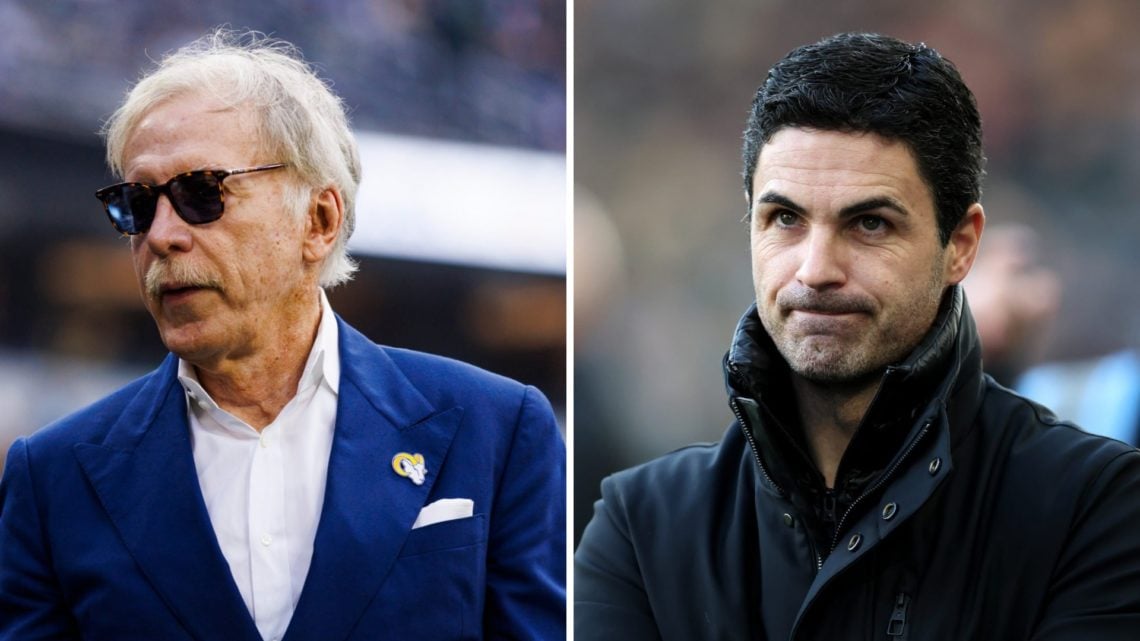

Arsenal’s transfer plans hinge on the plans of the hierarchy and how much Stan Kroenke is willing to invest in the future of the club.
The Gunners have ambitions of winning every piece of silverware available, with Kroenke already committing £324 million to Arsenal’s transfer business in terms of fees owed.
The current trajectory is to make the club self-sufficient in the market, only spending what they can afford within the model.
Part of the problem for Arsenal comes from their plan to create pathways for players, especially the younger ones they look to develop.
With the lack of a fully-fledged multi-club model, the Gunners could miss out on some clear talent for the future in the transfer market.
- READ MORE: Inside the life of Arsenal owner Stan Kroenke from net worth and sports teams to businesses

Stan Kroenke’s multi-club model problem at Arsenal
Arsenal technically do have more than one club under the ownership umbrella headed by Stan Kroenke.
The Colorado Rapids of the MLS are a sister club to the Gunners from KSE, though there isn’t a strong relationship between the two teams in the way other multi-club models work.
Arsenal don’t have a clear system in the same way the City Football Group do, and it may have already cost them dearly.
Transfer target Sverre Nypan was linked with a move to Arsenal, but instead looks set for a move to Manchester City, before a likely loan to Girona, part of the City Football Group model.
That clear plan that City could outline to Nypan as part of his development may have been the difference, with Arsenal unable to do so.
Finance expert Adam Williams spoke to Arsenal Insider about Arsenal’s lack of multi-club synergy under the Kroenkes and why it may be a problem.
“Stan Kroenke does own Colorado Rapids in the MLS, but it appears he’s not very engaged there,” he said on the model of KSE. “Fans have been asking for greater investment for years, and he hasn’t acquiesced. From his perspective, I’m not sure why that’s his position. Commercially, the MLS is one of the world’s most valuable leagues, and we’re seeing some enterprise valuations near £1bn over there.

“But either way, because the regulations are a bit more restrictive in the MLS and it’s a bit of a weird league in terms of competitive balance, they’re not really an ideal multi-club partner for Arsenal anyway. From what I understand, the relationship between the two clubs isn’t especially integrated.
“From Arteta’s comments, we know he’s interested in the multi-club model. It was also something that Edu wanted to be involved in. He’s going to take up this position with Nottingham Forest’s owner, Evangelos Marinakis, to oversee their multi-club aspiration. I’m speculating, but maybe that’s one of the reasons he left Arsenal if Kroenke wasn’t signalling that he wanted to go in that direction.

“There are lots of benefits to a multi-club model. But equally, there are a lot of complications too. From an owner’s point of view, depending on what kind of network you want to set up, you can share resources, spread costs and hedge your exposure in club ownership.
“With Arsenal, however, they would very much be the mothership of any multi-club structure, so – if Kroenke does ever decide to go down this route – it would be with more of an eye on player development pathways and so on rather than in commercial terms.
“The thing is with this model, though, you’re setting a limit to your own ambitions because of UEFA’s rules on dual-ownership with clubs in the same European competition.
“We’re at a bit of an inflexion point as far as the regulations are concerned. Some people I speak to think multi-club ownership is going to be more strictly regulated by UEFA in future, while others think it’s going to go in the complete opposite direction.
“Personally, I wouldn’t be happy if my club were acting as a feeder or subsidiary to another elite rival. I think we need to have a conversation about respecting the club’s unique identities. So there are strategic and moral concerns, in my view.”
In all, it means Arsenal may have missed out on a target or two and could lose out on more in the future without those clear plans and structure available for a player’s development.
However, there are more concerns for Kroenke to think about than just Arsenal if the system were to come into place, not least with a takeover of another club.

What Mikel Arteta has said about Arsenal’s multi-club model
The jury is still somewhat out on whether a multi-club model actually works, though the benefits for the top teams, like Man City, are that they can allow talent to develop before signing them.
Players like Savinho and potentially Nypan in the future can be examples of the model working, something that Mikel Arteta has admitted that he wants at Arsenal.
“Well, that’s something that a lot of clubs have at the moment,” the Arsenal boss said about the potential model.
“So, that restriction in the country has provoked that many other clubs have now, like sister clubs or multi-club systems to be able to do that. So, looking ahead in the future, it’s something basically to explore because obviously with the actual system it’s very, very difficult.
“Every club is very different in the way that they are set up, and the clubs that they have picked are various. But in our way, it’s obviously a decision from our ownership and the board to understand what is the best thing for the club in the future.
“My involvement is in the team and the squad. I have full trust in what the club has to do there, and they have to decide. If the club wants my opinion, then I’m more than happy to give that, but my focus is on the team.”
It’s clear that Arteta thinks the model could help Arsenal, whether that’s as a multi-club or within a partnership, but it remains to be seen whether they will follow that route.
Receive a digest of our best Arsenal content each week direct to your mailbox