Tomorrow, Arsenal will send a team of representatives on the short journey to an as yet undisclosed London location for what could be a landmark Premier League shareholders’ meeting.
For the Gunners, it is a profound moment for several reasons. Firstly, it is the first league-wide meeting since the departure of Tim Lewis, who until September was Arsenal’s vice-chair and, after the Kroenkes, the most powerful man at the club.
Richard Garlick has stepped up as CEO. While several new board members – Ben Winston, Kelly Blaha, Dave Steiner and Otto Maly – joined Arsenal earlier this year, they are all in non-executive roles. It therefore seems likely that Garlick will represent the club at Friday’s summit.
Lewis was something of a bulldog at Premier League shareholder meetings – a formidable and respected presence. As the right-hand man of Stan Kroenke, he was fiercely intelligent and trusted implicitly to be KSE’s representative in North London.
Secondly, and more importantly, the future of Premier League Profit and Sustainability Rules (PSR) is on the agenda. And for the Kroenkes, whose eventual return on investment will likely be dictated by the financial ecosystem that PSR has helped form, it could be a seismic day.

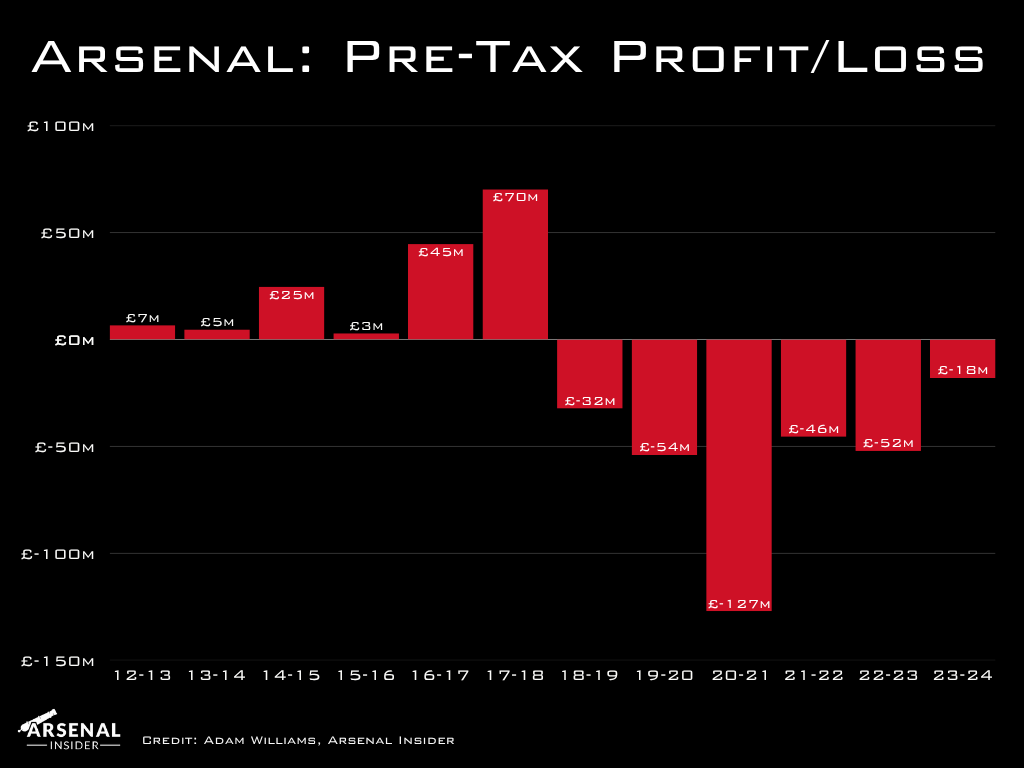
In recent years, KSE have furnished Mikel Arteta with the funds needed to make Arsenal a superpower once again. In fact, partly because of the increase in wage and transfer spending, the club hasn’t turned a profit in six seasons, with Kroenke providing hundreds of millions in interest-free loans to fund the losses.
Eventually, however, the owners want the club to stand on its own two feet financially, and consistently. Otherwise, it will be hard to justify the multi-billion pound asking price when the Americans do eventually come to sell the club.
For that reason, a stricter PSR system which inhibits ambitious upstart clubs who might otherwise be able to match Arsenal’s spending is, on surface level, in the club’s interests.
However, their stance appears to be moving.
Arsenal’s budget under overhauled PSR system
Under the current PSR system, Arsenal are permitted to lose up to £105m over a rolling three-year period.
They are also allowed to add back certain types of expenditure, such as academy, women’s team and infrastructure investment. But even without those add-backs, Arsenal are well within that limit.
Where things get somewhat trickier is with UEFA’s parallel financial rules. The European governing body has a similar system to the Premier League’s but with a lower threshold of around £75-80m, depending on exchange rates. Again, however, Arsenal have no concerns here.
How should Arsenal vote on PSR?
But UEFA also runs a Squad Cost Ratio test, under which Arsenal are permitted to spend no more than 70 per cent of revenue plus a three-year average of player sale profits on first-team wages, transfers and agents’ fees. This is a calendar year test, measured for the 12 month up to 31 December, not on a rolling three-year period.
As an illustrative example, Arsenal’s 2023-24 accounts (the most recent available) would have permitted them a spend of about £449m. Again, it’s a calendar-year test, so the 23-24 accounts don’t give a reliable picture of their actual Squad Cost Ratio, but the numbers do give a flavour of what compliance looks like.
Arsenal had some anxieties about their Squad Cost Ratio in the summer after increasing the wage bill and spending around £250m net on transfers. Now, the mood music is that they should be okay, but that situation is a useful acid test given that the Premier League will on Friday vote whether or not to introduce their own Squad Cost Ratio, albeit with a more lenient cap of 85 per cent. Based on the 2023-24 figures, their hypothetical spending cap would have been £545m.
Also on the agenda is a top-to-bottom anchoring, a system under which Arsenal would be limited to spending around five times what the bottom-placed club earns in central payments from the Premier League in a season. Using the most recent figures, that sets a limit of £546m
Arsenal’s actual spend in 2023-24 across the relevant categories was about £315m, assuming that 75 per cent of their £238m wage bill was spent on the first team.
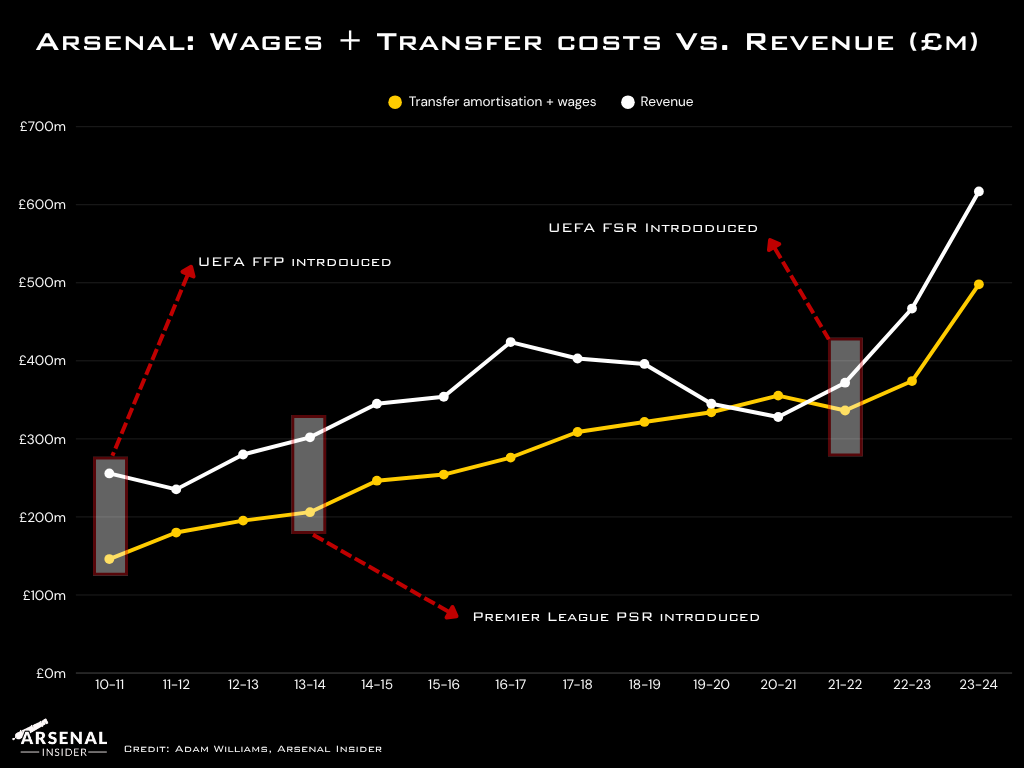
Estimates for the club’s spending in 2024-25 by football finance expert and author of the Vanity Sanity and Reality newsletter Greg Cordell, however, put their spending for the season at close to £442m, which is close to the hypothetical UEFA Squad Cost Ratio limit we outlined earlier.
Revenue will likely increase this year, but so too will costs. That means that, while Arsenal aren’t imperilled by UEFA or the Premier League’s rules, they will be a significant factor when setting budgets going forward.
In any case, there are doubts that the Premier League will get the two-thirds majority that it needs in order to vote through the proposals for anchoring and the ratio system.
Both systems have been trialled on a non-binding basis for the last season-and-a-half, but there are concerns that they could be open to legal challengers.
Indeed, the PFA and several leading player agencies have said that they will contest the anchoring system if it is introduced.
And while Arsenal’s historic stance has been to advocate for robust financial limits, it appears that they have their doubts about the proposed new system at domestic level too.
Reports this week suggest that they are considering joining the two Manchester clubs in voting against the new rules. A handful of other clubs will do the same.
If seven or more clubs vote together – or if there are abstentions – then they effectively have a veto.
Either way, an evolution of the existing PSR system is coming. Clearly, there is not a consensus about the specifics of the regulations, but the feeling among insiders is that, after over a decade of the existing system at domestic level, change is needed.
Receive a digest of our best Arsenal content each week direct to your mailbox