

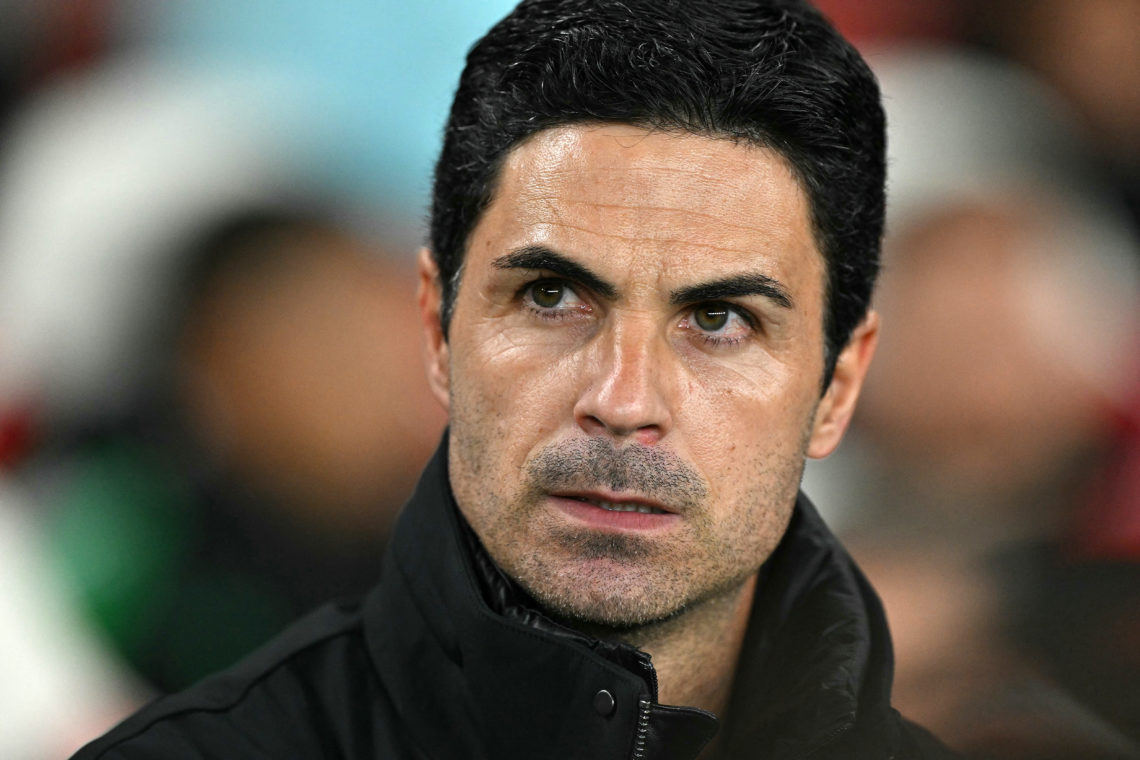


Mikel Arteta has consistently deployed a 4-3-3 formation at Arsenal.
The Gunners have been set on this system since the 2021/22 season, when the Spaniard felt he had the players he required to emulate Pep Guardiola’s model.
However, the North Londoners are seriously depleted in forward areas, and thus Arteta should contemplate making some changes to his usual set-up.
Bukayo Saka is expected to return in March, while Gabriel Martinelli is out for a month and Gabriel Jesus will miss the next nine months with an ACL injury.
Meanwhile, Kai Havertz has also picked up a suspected injury, although this is yet to be confirmed by the club.
With this threadbare offensive cohort in mind, here are two potential formations Arteta could use while he’s waiting for the likes of Saka and Martinelli to return to fitness.

Mikel Arteta could switch to a back three
Arteta’s team essentially already builds up in a 3-2-5 shape, with one of the full-backs forming a back three with the centre-backs, while the other full-back inverts into midfield to sit alongside the number six.
However, the Arsenal boss should consider making it more of a traditional 3-5-2 in and out of possession, with more natural wing-backs deployed.
With attacking options sparse, removing an attacking player and fielding more of your better players makes logical sense.

This system would suit a number of players in Arteta’s squad.
Jurrien Timber is accustomed to sitting on the right of a back three, while Riccardo Calafiori or Myles Lewis-Skelly would be afforded greater offensive freedom, which fits their adventurous personalities on the pitch.
Ben White has returned to first-team training, and is expected to return to the matchday squad against Leicester City on the weekend.
The Englishman’s marauding overlapping runs were a threatening feature for Arsenal last season, and this formation would allow him to focus on this aspect of his game.
Meanwhile, Declan Rice and Thomas Partey are naturally suited to playing in a double pivot, and Martin Odegaard can be liberated as an offensive force as a ten.
Neither Leandro Trossard or Kai Havertz are arguably out-and-out strikers, but this system allows them to play up front together and lead the press, a combination that worked well for Arsenal at times when Odegaard was absent earlier in the season.

Mikel Arteta could go all out attack
Instead of leaning into defensive solidity, another way to combat missing your best attacking player is to field as much attacking threat as you possibly can.
Without Saka, Arsenal lack creative poise in the final third, so putting numerous forward players on the pitch at the same time may help to negate this to an extent.

Arteta is unlikely to, and probably ought not to, select this system against high quality opposition, but away at struggling Leicester it’d probably suffice.
With the most frequently picked midfield trio in their usual roles, this isn’t too dissimilar to how Arsenal typically set up, although it involves introducing an additional attacker.
Essentially, a full-back has been removed to provide Havertz with a strike partner in the form of Trossard.
In what is ultimately a 3-3-4 shape, the wide centre-backs would have to be very capable of defending wide areas isolated against wingers, while Partey would have to remain very disciplined.
Both these defensive conditions are within the Ghanaian, Timber and Gabriel Magalhaes’ skillsets, thus meaning this formation could be perfect for smothering lesser teams in the Premier League.
Receive a digest of our best Arsenal content each week direct to your mailbox


